

When I was an undergrad in the late 2000s, I learned how to tie a tie through a paper by Fink & Mao: https://lims.ac.uk/wp-content/uploads/paper_physica_a.pdf. Mostly for the novelty, I was wearing ties nearly every day for a couple of years.
I kept a printout around of Fink & Mao’s table of aesthetic tie knots, that I used to tie different knots based on the language Fink & Mao created to describe knots. Even to this day, I mostly do four-in-hand, and remember “lirolicot” when I make it.
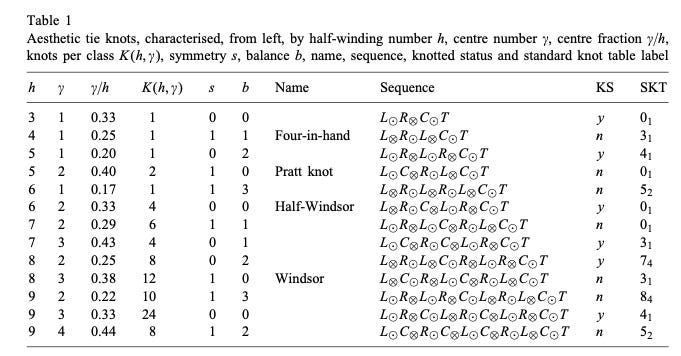
As an aside: I didn’t realize until now (when looking up the paper for this post) that Fink & Mao were at TCM (theory of condensed matter) at the Cavendish labs in Cambridge! My supervisor had a partial appointment there during my PhD, several years later, and I went there a few times for meetings and collaborations.
One summer during those years I was interested in learning more interactive programming. The best way to learn programming was to build something that you were interested in. I started building a simulator for textured tie knots using Microsoft XNA Game Studio Express. Unfortunately I wasn’t able to find any old screenshots. I didn’t get particularly far with it; the last thing I remember working on was folding a ribbon around the knot position while expanding the width.

In particular, I wanted to be able to see how different patterns would end up looking after they were tied with different knots. How angles in the knot will look against angles in the unknotted part. How distracting it gets with asymmetric knots. Etc.
When GPT 6.1 Astra was released, I happened to be thinking about neck ties, and thought it would be an interesting project to test it with. It made a nice Mac interface, but I think I was a bit unclear in my instructions, and it went down a rabbit hole of performing physically realistic simulation of how cloth bends. This led it to pre-render knots for four common tie knots with the ability to switch out the pattern of the fabric, which arguably is useful. Even though the Fink & Mao paper discovered novel tie knots, the classical Pratt, half-Windsor, and Windsor tie knots have the best looks to them.
Eventually when Fable 5.2 was released, I thought this would be a an application to test it with. Anthropic provides specific guidance on the effectiveness of giving Fable 5.2 ownership of an established code base. I gave the code base over to Fable 5.2 and commented that the direction we want to go in is snappy support for rendering arbitrary tie knots from the Fink & Mao language of tie knots.
Now I have a nice Mac-native application for simulating all possible tie knots!
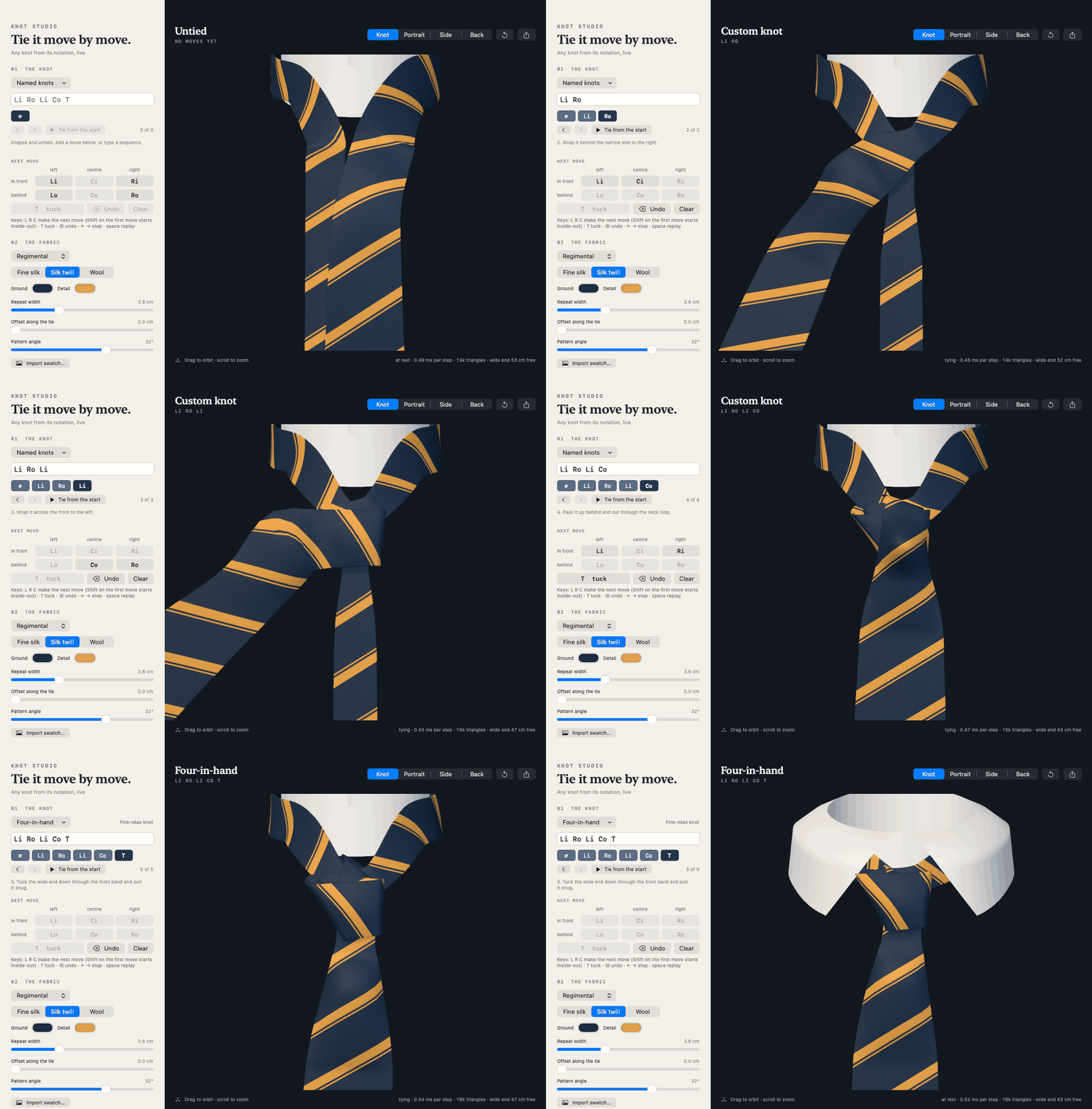
It’s on GitHub here: https://github.com/vals/knotstudio
From around the web
A single-cell RNA-seq catalog of ground truth gene coregulation
Bioinformaticians have been writing the same abstract for decades
Antidotes to cynicism creep in academia - I think I agree more with the cynisism part than the antidotes part
Why were Victorian elites so effective? - Education from before the Committee of Ten in 1892 is interesting. The way modern education is focused on curriculum without reflection on more general outcomes seems like results from arbitrary decisions.
Today’s Computers Are Broken, Let’s Figure Out What’s Next - MacOS is heading down a poor path of monetization, but I’m surprised so many people are going for Linux desktop rather than the Mac platform now that Windows is dead.
It’s hard to write code for computers, but it’s even harder to write code for humans
Ana Montes did much harm spying for Cuba. Chances are, you haven’t heard of her.
