

I was thinking about my reading habits. I used to read a lot of novels and non-fiction, but I don’t anymore. On the other hand, I enjoy spending time reading immunity and inflammation papers. Thinking back, the number of books I read decreased as the number of papers I was reading increased.
Recently, I was reading a review on tissue homing of lymphocytes by Kunkel & Butcher from 2002. Cells that are native to a tissue release proteins that guide necessary immune cells to the tissue. Different native cells act as sources for proteins that recruit different immune cells. The different immune cells have different receptors that sense these secreted proteins.
In the review by Kunkel & Butcher, they list various recruiting proteins (ligands, chemokines), and which tissues they are expressed in, as well as which immune cells express corresponding receptors.
I had recently been exploring a mouse gut scRNA-seq dataset from Hong et al published in 2024. Focusing on gut, I wanted to visualize how cell communication described by Kunkel & Butcher related to the Hong et al data.
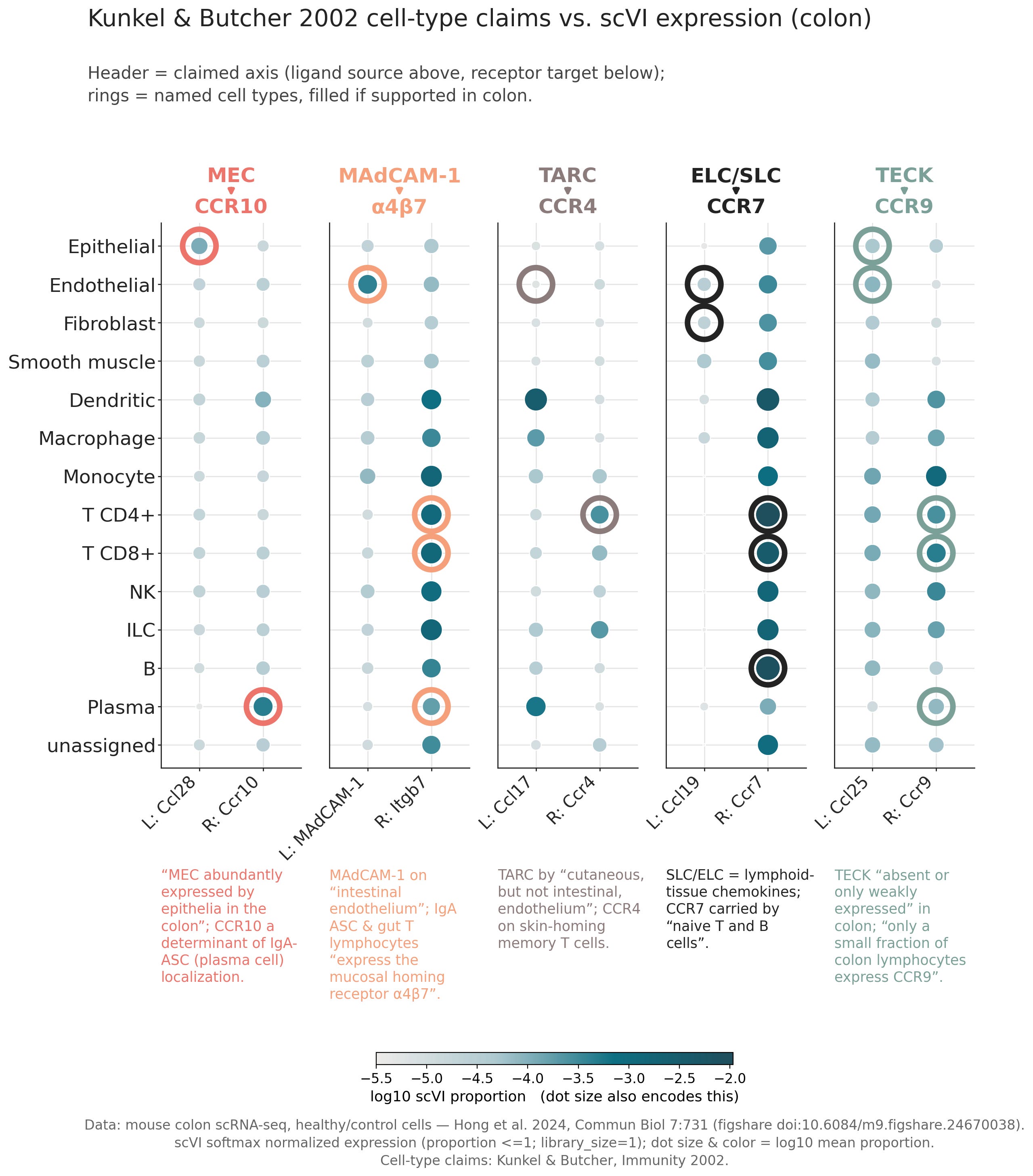
The scRNA-seq data, published 22 years after the review, largely reflect the described relations. Immune cells express the described receptors. Gut epithelia have high expression of Ccl28 (MEC), while gut endothelium expresses high levels of MAdCAM-1.
On the negative side, it’s a bit tougher. Gut endothelium has very low levels of Ccl17 (TARC), but on the other hand gut has Ccl17 sources in dendritic cells and plasma cells. Ccl19 and Ccl25 supposedly have low expression in the gut, and we see the levels are somewhat low, but other cells have lower expression levels.
Ccl19 is annotated to guide cells to lymphoid tissue, and Ccl17 more highly expressed in cutaneous tissue. I didn’t have data at hand for this, but since we usually think about expression in relative terms, here is a case where comparing expression levels in those tissues to gut expression levels would be reasonable.
We are looking at gene expression here. It raises the question: how much gene expression of chemokines would there need to be in order to meaningfully contribute to tissue homing?
From around the web
